Self-employed regime in Kazakhstan (2027): who qualifies and what you pay
What changed
Added the 2027 limit and payments under the draft budget, examples for 150,000 and 300,000 tenge, official counts of the self-employed as of 1 October 2026, the permitted list under resolution No. 994 and the position of pensioners.
In short
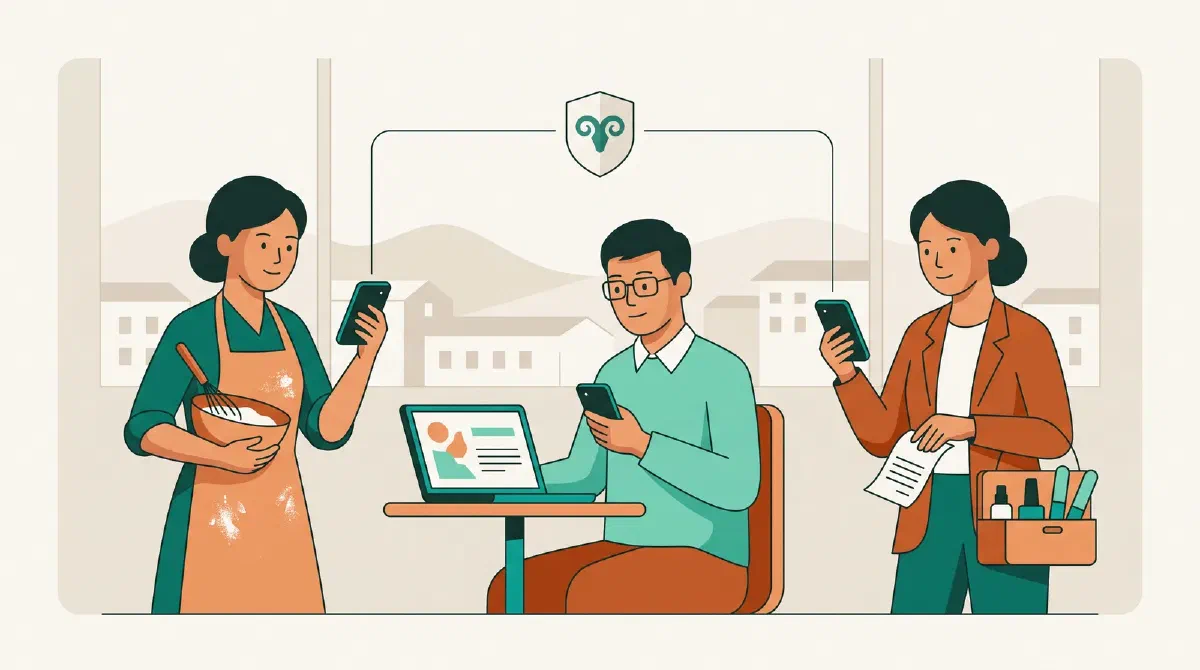
- Since 2026 a self-employed person in Kazakhstan is an individual without individual entrepreneur (IP) registration: a Kazakh citizen or kandas, with no employees, an activity on the government's permitted list and income of no more than 300 MCI a month (1,297,500 tenge in 2026; 1,407,900 tenge in 2027 under the draft budget).
- Foreign citizens cannot use the self-employed regime (Tax Code art. 718 para. 2); a foreigner can open an IP only as a citizen of an EAEU country or Tajikistan with a Kazakh residence permit.
- A self-employed person pays income tax at 0% and social payments of 4% of monthly income, 1% each for social contributions, pension, employer pension and health insurance; on 200,000 tenge that is 8,000 tenge a month.
- The regime starts with the first receipt issued in the e-Salyq Business app of the State Revenue Committee, and payments are due by the 25th of the following month; an online platform operator withholds the taxes for income earned through it.
- Income above 300 MCI in a month, or a hired helper, means filing a notice to start business as an IP within 5 working days.
Kazakhstan's self-employed regime, in force since 1 January 2026, lets an individual work alone without registering as an individual entrepreneur (IP, the Kazakh sole trader status) and earn up to 300 MCI a month, 1,297,500 tenge in 2026 (1,407,900 tenge in 2027 under the draft budget law). Income tax is 0%, and the only cost is social payments of 4% of monthly income: 8,000 tenge on 200,000 tenge. The regime starts with the first receipt in e-Salyq Business, a free app of the State Revenue Committee (KGD), with no visit to a tax office.
For a foreign reader the key point comes first: the regime is closed to foreign citizens. Article 718 of the 2026 Tax Code limits it to citizens of Kazakhstan and kandases (ethnic Kazakhs who resettled and hold that legal status). If you are a foreigner planning to freelance or trade in Kazakhstan, the section below on foreigners' options is the one that applies to you. The rest of the page explains the regime for Kazakh partners, contractors and employees you may deal with: who qualifies, how payments are calculated, and when someone has to move to an IP.
Who qualifies for the self-employed regime?
A Kazakh citizen or kandas who is not an IP, has no employees, works in a permitted activity and earns up to 300 MCI (monthly calculation index) a month. Article 718 sets no other conditions: no age limit and no separate annual cap.
The narrowest condition is the activity. The self-employed regime uses a permitted list: the government approves what you may do under it, and everything not on the list is excluded. The simplified regime works the other way round, with a prohibited list, so anything not banned is allowed. Before the first receipt, check the activity code (OKED, the Kazakh classifier of economic activities) in our explainer on OKED codes.
The regime does not allow hired help: the Code says "not using the labour of employees". If two people bake cakes and one is paid by the other, that is a business with an employee, and it needs an IP. Age is not a condition, so a pensioner can formally use the regime, but KGD guidance we reviewed does not explain how the app calculates pension contributions for pensioners.
What can a foreigner do instead?
A foreigner has three realistic routes, and none of them is the self-employed regime. The choice depends on citizenship, residence status and whether you will hire people.
| Your situation | Self-employed regime | Individual entrepreneur (IP) | Limited liability partnership (LLP) |
|---|---|---|---|
| Citizen of Kazakhstan or kandas | yes | yes | yes |
| Citizen of Russia, Belarus, Kyrgyzstan, Armenia or Tajikistan with a Kazakh residence permit | no | yes, according to KGD guidance | yes |
| Citizen of any other country | no | no | yes, as a founder |
IP for EAEU and Tajik citizens. According to KGD guidance, citizens of Russia, Belarus, Kyrgyzstan, Armenia and Tajikistan who hold a Kazakh residence permit may register an IP; citizens of other countries cannot. An IP can then choose the simplified regime, but only if the owner is a Kazakhstan tax resident. The steps are in how to open an IP.
LLP for everyone else. A foreign citizen can be a founder of a limited liability partnership (LLP, TOO in Russian). Options for foreign founders are compared in our guide to starting a business in Kazakhstan as a foreigner, and the trade-offs in IP or LLP.
Working for a Kazakh company. Another route is an employment or civil law contract with a Kazakh business; the differences between the two are explained in employment contract or civil contract. Migration and work permit rules for foreigners are outside the scope of this page. Tax residency, which decides how such income is taxed, starts after 183 days in Kazakhstan in any consecutive 12 months; see the tax residency guide.
How much does a self-employed person pay?
Four percent of monthly income, all of it social payments. Individual income tax formally applies, but at a rate of 0% (Tax Code art. 720).
The 4% is four payments of 1% each: social contributions, the compulsory pension contribution (OPV), the employer pension contribution (OPVR) and health insurance. The first three come from Article 101-1 of the Social Code and the health contribution from Article 28 of the health insurance law. The split "4% = 1 + 1 + 1 + 1" is our sum of the two laws; no single act states it in one line.
| Monthly income | Social contributions 1% | Pension 1% | Employer pension 1% | Health insurance 1% | Total |
|---|---|---|---|---|---|
| 100,000 tenge | 1,000 | 1,000 | 1,000 | 1,000 | 4,000 tenge |
| 200,000 tenge | 2,000 | 2,000 | 2,000 | 2,000 | 8,000 tenge |
| 500,000 tenge | 5,000 | 5,000 | 5,000 | 5,000 | 20,000 tenge |
| 1,297,500 tenge (the 300 MCI limit) | 5,950 | 12,975 | 12,975 | 12,975 | 44,875 tenge |
The last row is not exactly 4% because the base for social contributions is capped at 7 minimum wages, 595,000 tenge in 2026, so they stop growing at 5,950 tenge. The base for the two pension payments is capped by the regime limit of 300 MCI. Unlike an IP on the simplified regime, a self-employed person has no minimum payment: no income, no payments.
What changes in 2027
The four 1% rates stay the same in 2027 (Social Code art. 101-1 and the health insurance law). The employer pension contribution rising to 4.5% in 2027 under article 251 applies to employers and to IPs paying for themselves, not to this regime. Only the tenge limit and the cap on social contributions move: the limit follows the MCI, the cap follows the minimum wage.
| Monthly income | 2026 | 2027 |
|---|---|---|
| 150,000 tenge | 6,000 tenge | 6,000 tenge |
| 300,000 tenge | 12,000 tenge | 12,000 tenge |
| Regime limit, 300 MCI | 1,297,500 tenge | 1,407,900 tenge (draft) |
| Payments at the limit | 44,875 tenge | 48,187 tenge at a minimum wage of 85,000; 49,937 tenge at 110,000 |
The 2027 minimum wage is still open: the draft budget keeps 85,000 tenge, while the President's address of 28 October 2026 instructed raising it to 110,000 tenge. That puts the social contribution cap at 595,000 or 770,000 tenge. The 2027 MCI of 4,693 tenge comes from the draft budget law; the figures become final once the law is signed.
How does someone become self-employed?
They install e-Salyq Business and issue the first receipt in it; the regime starts on that date. No application to the tax office and no IP registration are needed.
- Check the activity. It must be on the government's permitted list. If it is not, the app is the wrong route, and an IP is the alternative.
- Install e-Salyq Business. It is a free KGD app for App Store, Play Market and App Gallery. The Tax Code makes the special mobile app mandatory for the self-employed (art. 719).
- Issue the first receipt. The regime starts on the date of the first receipt generated in the app (Tax Code art. 716 para. 9; KGD guidance of 20 January 2026). Receipts form the income register on which payments are calculated.
- Pay by the 25th of the next month. Income tax at 0% is formally due by the 25th (art. 720 para. 4), and social payments by the same date under the Social Code. Payments can also be made in advance for the current and later months of the year.
- Watch the monthly limit. As monthly income approaches 1,297,500 tenge, decide whether to move to an IP.
The order follows from the design: the regime is tied to receipts, not to an application. The tax authority sees income in the app and uses the same data to deregister a person after a month with no income.
When does an online platform pay the tax?
When income comes through an online platform, its operator becomes the tax agent and withholds and transfers income tax and social payments itself (Tax Code art. 721). The platform transfers income tax by the 15th of the following month.
That has two consequences. Income already taxed by the agent reduces the person's own tax base (art. 720 para. 2), so the same amount is not taxed twice. And when some orders come through a platform and others directly from clients, the person pays for the direct orders through the app.
Under the Code, banks and online platforms may generate receipts on behalf of a self-employed person (art. 717 para. 5), but KGD has not published a list of services doing this in 2026. In areas without mobile coverage the Code allows the person to calculate and pay tax on their own, keeping a simple income record (art. 719).
Did the regime start on 1 January or 1 March 2026?
Under the Tax Code, on 1 January 2026. Some early 2026 news reports named 1 March as the start, and the two dates come from different events.
1 January 2026. The new Code took effect as a whole on that date. The exceptions cover only Article 189, Article 92 and Chapter 90; Chapter 77 on the self-employed has no separate date (art. 848). For an individual, the regime starts with the first receipt in the app.
1 March 2026. A January explainer on choosing a tax regime, circulated by primeminister.kz and the media, presented the regime this way. In KGD's Zhetisu department news of 20 January 2026, 1 March is the date when tax authorities automatically deregistered IPs that had used the patent or the mobile app regime in 2025.
In practice, 1 March was a one-time transitional event of 2026 (art. 840 para. 1): former patent IPs who chose no other regime were deregistered with effect from 1 January 2026. Such a person becomes self-employed with the first receipt. For a newcomer, 1 March changes nothing.
What did the regime replace?
It replaced the patent and the mobile app regime, both abolished. Before 2026 Kazakhstan had 7 special tax regimes; from 1 January 2026 three remain: the self-employed regime, the simplified regime and the regime for farms.
| Parameter | Before 2026: patent and mobile app | From 2026: self-employed |
|---|---|---|
| Status | IP | not an IP, an individual |
| Income limit | 3,528 MCI per year | 300 MCI per month (1,297,500 tenge) |
| Who may apply | IPs under the 2017 Tax Code | only Kazakh citizens and kandases, without employees |
| Tax | under the 2017 Tax Code | income tax at 0% |
| Social payments | under the 2017 Tax Code | 4% of income |
| Start | IP registration | first receipt in e-Salyq Business |
IPs on the patent and mobile app regimes who did not file a notice to move to the simplified regime were deregistered automatically on 1 March 2026 (Tax Code art. 840 para. 1). Those who filed stayed IPs on the updated simplified regime. The full list of what was abolished is in the review of regimes abolished in 2026.
How many people use the regime?
As of 1 October 2026, 981,200 people applied the regime, 807,300 of them new to it. Deputy Prime Minister Serik Zhumangarin gave these figures in a reply to a parliamentary inquiry, published by Zakon.kz on 27 October 2026. For scale: in the first 10 days of January 2026, according to KGD, about 66,000 people became self-employed (Forbes Kazakhstan, 10 January 2026).
| Indicator, 1 October 2026 | Value |
|---|---|
| Total self-employed | 981,200 |
| Working through online platforms | 866,900 (88%) |
| Working on their own | 114,200 (12%) |
| Taxi | 519,683 (53%) |
| Courier delivery | 292,509 (30%) |
| Social payments for platform workers | 16.1 billion tenge |
The regime is mostly taxi and delivery work, 83% of participants, and most of it runs through platforms that withhold payments themselves. For a foreign company hiring Kazakh contractors, this means a local driver or courier is often self-employed rather than an IP. Some came from IP status: of the 356,000 IPs deregistered in the first nine months of 2026, 20.8% moved to the self-employed regime (Kapital.kz, 13 October 2026). An IP has to be closed first, because only a person who is not an IP qualifies (art. 718); the steps are in how to close an IP.
When does a self-employed person have to open an IP?
When monthly income exceeds 300 MCI, an employee is hired, or the activity is not on the permitted list. Within 5 working days of breaking a condition, the person must file a notice to start business as an IP (Tax Code art. 716 para. 11).
If a large deal is expected to push income over the limit, the notice is filed before the money arrives. The new regime counts from the date the mismatch arose, not from the notice date. For applying a special regime in breach of its conditions, the Code of Administrative Offences (art. 270) provides a warning the first time and a fine for a repeat within a year; amounts are in the guide to fines for entrepreneurs.
How an IP differs: on the simplified regime the limit is 600,000 MCI a year, the Code sets no cap on employees, tax is 4% of income (the maslikhat, the local council, may change the rate by up to 50%), and the IP pays social payments for themselves every month, even on low income. In return an IP gets freedom of activity and the right to hire people.
Why do self-employed people lose the status?
The problem usually shows in the app: it refuses a receipt or shows that the regime has ended.
| What you see | Why | What to do |
|---|---|---|
| The app rejects the activity | it is not on the government's permitted list | check the OKED code; if excluded, register an IP |
| The regime has ended | a calendar month passed with no income, and the tax authority deregisters (art. 716 para. 13) | the start date is the first receipt; check in the app whether a new receipt restored the status |
| Monthly income above 1,297,500 tenge | the 300 MCI limit is exceeded | file a notice to start an IP within 5 working days |
| A permanent helper is needed | the self-employed may not use employees | open an IP; the simplified regime has no headcount cap |
| A former patent IP now shows as "closed" | automatic deregistration on 1 March 2026 with effect from 1 January 2026 | work as self-employed from the first receipt or register an IP again |
| A payment debt appears | payment missed the 25th | check the debt by IIN (individual identification number) and pay it; late payment interest accrues |
How late payment interest is calculated is explained in the guide to late payment interest on taxes.
Where is the regime weaker than it looks?
Three limits are worth knowing in advance. Pension savings stay small: a 1% pension contribution builds far less than the 10% an employee pays. The limit is monthly, so one strong month above 1,297,500 tenge moves the person to an IP even if average annual income is lower. And the regime does not scale: the first employee means an IP.
The permitted list is narrow. Government resolution No. 994 of 21 November 2025 names 40 activities, such as repair of household goods and equipment, finishing work, taxi, food delivery, renting out housing, tutoring, photography, translation and hairdressing. Software development, design and marketing are not on it, so those freelancers need an IP. Pensioners can use the regime, since age is not a condition; a district tax office and Kaspi.kz told Digital Business in January 2026 that pensioners by age pay none of the four contributions, though no legal provision was cited. Other business rules are summarised in the overview of the Entrepreneurial Code, and all tax regimes, rates and deadlines are in the taxes section.
What next
- How to register as a sole proprietor (IP) in Kazakhstan in 2027Sole proprietorship in Kazakhstan 2027: who may register an IP, including foreigners, online channels, one…
- Kazakhstan's simplified tax regime in 2027: rate, income limit, who qualifiesKazakhstan tax rate for small business in 2027: the simplified regime charges 4% of income, cut to 2% or 3% in…
- Tax calendar for sole proprietors in Kazakhstan (2026-2027)Kazakhstan tax calendar for 2027 and 2027: filing and payment dates for forms 910, 220, 200 and 100 by tax…
- TaxesKazakhstan small business tax in 2027: what an IP pays on the simplified and general regimes or as…

Frequently asked questions
Can a foreigner register as self-employed in Kazakhstan?
How much does a self-employed person pay in Kazakhstan in 2026?
What is the income limit for the self-employed regime in 2026 and 2027?
Did the self-employed regime start on 1 January or 1 March 2026?
Can a pensioner be self-employed in Kazakhstan in 2026?
How many self-employed people are there in Kazakhstan?
Sources
Figures on this page were checked against these documents. Spotted a mismatch? Tell the editors.
- Tax Code of the Republic of Kazakhstan No. 214-VIII of 18 July 2025: art. 715-721 (self-employed regime), 716 (start date, change of regime), 722-723 (simplified regime), 840, 848 · checked 3 October 2026
- Social Code of the Republic of Kazakhstan: art. 101-1, social, pension and employer pension contributions of the self-employed at 1% each; art. 246, 248, payment dates · checked 3 October 2026
- Law on Compulsory Social Health Insurance: art. 28, contributions of the self-employed at 1% · checked 3 October 2026
- Law on the Republican Budget for 2026-2028: MCI 4,325 tenge, minimum wage 85,000 tenge · checked 3 October 2026
- State Revenue Department for Zhetisu region (KGD): deregistration of patent and mobile app IPs on 1 March 2026, self-employed regime from the first receipt in e-Salyq Business, 20 January 2026 · checked 7 October 2026
- State Revenue Department for East Kazakhstan (KGD): changes to special tax regimes from 2026, 23 February 2026 · checked 7 October 2026
- Tax Code of 2017 (repealed on 1 January 2026): limits of the patent and mobile app regimes, art. 683 · checked 31 December 2025
- Draft law on the republican budget for 2027-2029: MCI 4,693 tenge, minimum wage 85,000 tenge · checked 16 November 2026
- President's address of 28 October 2026: instruction to raise the minimum wage to 110,000 tenge · checked 16 November 2026
- Government resolution No. 994 of 21 November 2025: permitted activities for the self-employed regime (40 items) · checked 16 November 2026
- Zakon.kz, 27 October 2026: Deputy Prime Minister S. Zhumangarin's reply to a parliamentary inquiry, 981,200 self-employed as of 1 October 2026, 88% via platforms, taxi 53%, couriers 30%, social payments 16.1 billion tenge · checked 16 November 2026
- Kapital.kz, 13 October 2026: 20.8% of the 356,000 IPs deregistered in January to September 2026 moved to the self-employed regime · checked 16 November 2026
- Digital Business (digitalbusiness.kz), 30 January 2026: tax office and Kaspi.kz on payments of self-employed pensioners · checked 16 November 2026
Related guides
- How to register as a sole proprietor (IP) in Kazakhstan in 2027
- Kazakhstan's simplified tax regime in 2027: rate, income limit, who qualifies
- Starting a business in Kazakhstan as a foreigner (2027)
- Tax regimes abolished in Kazakhstan in 2026 and where to switch
- What an OKED code is and how to choose one